Wednesday, March 5, 2014

Spring Workshops!


Journal Submission Process - March 6th, 2pm

While each journal does things somewhat differently, the overall submission process for an academic journal is fairly standard, and it can be useful when thinking about or working on an article for such a journal to know what is expected of you and what you can expect from the journal. This session will discuss the process of being published, including peer reviewing and your rights as an author.

Thesis and Dissertation Workshop  March 19th-2pm, March 26th-4pm

 For all students working on a thesis or dissertation, this workshop will provide details about formatting & submission requirements. Location: Library Training Room 204.

Issues in Scholarly Communication - Mar 20th, 2pm

Scholarly communication refers to the many ways scholars communicate with each other, which include articles, conferences, blogs, Twitter, and much more. We'll discuss the latest news in scholarly publishing, open access, and other current events in the area of scholarly communication.

Using Altmetrics in Citation Tracking - Apr 3rd, 2pm

"Altmetrics" is the term given to the new means of tracking citations through technology like Twitter and online communities. This session will go over what altmetrics are, where you can find them, and how you can use them in tracking your impact as an author.

Business & Company Research - Apr 17th, 2pm

Looking for a job or just for information? Come learn how to find out more about the companies and industries you're interested in so you can approach the application process with confidence.

All Workshops will be held in Library Room 204.

Monday, February 24, 2014

Stevens' Alum Worked To Better Living Conditions of Many

By Leah Loscutoff,
Archives & Special Collections Librarian

Special thanks to Doris Oliver, Assistant Curator, for her assistance with the research for this blog post.

This is the second article honoring Black History Month at Samuel C. Williams Library

In 1937, esteemed Stevens alumni James Sylvester Braxton graduated. That same year heavyweight boxing champion Joe Louis held his championship title, and the "Girl With the Honey-Coated Voice" jazz singer Nancy Wilson was born. Mr. Braxton was born on July 21, 1914, and lived on Wegman Parkway in Jersey City while attending Stevens.  

During his undergraduate days here he held a four-year Edgar B. Bacon scholarship and participated in numerous social and professional activities, which included involvement with the “Stute” and the Dramatic Society.  He was elected to the Tau Beta Pi fraternity and was also on the Dean’s list. He’s described in the 1936 Link yearbook as one of the most active members of his class. He was well known around campus and had a great academic record.

As described in a 1987 article in the Stevens Indicator, Braxton went off to have a successful career. He held positions as chief engineer for a general contracting firm and as instructor at Howard University in Washington D.C. He entered Harvard University in 1945 and was awarded a Julius Rosenwald Fellowship for graduate studies in regional planning. He earned the Master of City planning degree from Harvard Graduate School of Design.

After graduating from Harvard, Mr. Braxton moved into a new phase of his career. He was led by his lifelong passion to design and manufacture low-cost housing systems.  After working as site planner of international housing projects for the New York firm of Skidmore, Owings and Merrill and the International Basic Economy Housing Corporation, Mr. Braxton became supervising senior planner with the Chicago Housing Authority in 1950. In 1965, he assumed the position of assistant chief engineer with the Metropolitan Sanitary District of Greater Chicago. In 1981 Mr. Braxton left this position to become Vice President of Globetrotters Engineering Corporation. He continued his dream of producing reduced cost housing systems. As president of Braxton Inc., he has patented the Braxton Inc., which is a system of manufactured housing that can be assembled by unskilled labor with a minimum of training.

In 1987 Mr. Braxton returned to Stevens to receive an honorary degree and was quoted as saying:

“I have enjoyed being an engineer. It has both stimulated and satisfied my curiosity. My engineering training has enabled me to be more creative . . . Last year, I obtained a U.S. Patent on a systems approach to housing construction. Although the system will permit construction of any type building, anywhere, the shortage of affordable housing, and the presence of so many unemployed in the inner city make it an attractive starting place. For example, I would like to see pilot projects in Newark and Chicago. I believe that a properly-designed housing system such as the one I am developing, erected by semi skilled workers could cut the cost of decent housing by a factor of one third to one half.” 


Mr. Braxton accomplished much during his amazing career, and we would like to honor him this month of February, which is Black History Month. He spent his life’s work on bettering the conditions of his fellow man, and his ingenuity and determination is inspiring. Mr. Braxton will turn 100 years old this year, and still lives in the Chicago area.  

Wednesday, February 12, 2014

Honoring Black History Month at SC Williams Library

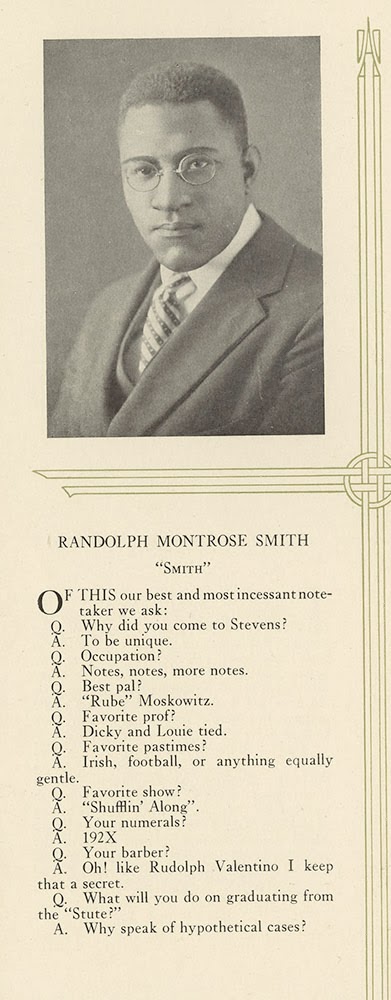
Randolph Montrose Smith seated in the third row with
graduating class of 1924 in front of the EAS Building.

By Leah Loscutoff,
Archives & Special Collections Librarian

Special thanks to Doris Oliver, Assistant Curator, for her assistance with the research for this blog post.

Since 1976, the month of February has been officially designated as Black History Month.

In the year of 1924, DeHart Hubbard was the first African American to receive an individual Olympic medal for the long jump. That same year Shirley Chisholm was born in Brooklyn, New York. She went on to become the first African-American woman elected to Congress in 1969.

Also in 1924, the first African-American student graduated from Stevens Institute of Technology. Randolph Montrose Smith was born in Barbados in 1901. He was just two years old when he arrived in New York City in 1903 on a ship named the Cearense. Unfortunately, not too much is known about Randolph, but we do know that he lived in upper Manhattan on West 140th Street while attending Stevens.

Searching the 1930 census records we also learned that he was working as a Civil Engineer for the Manhattan subway system after he graduated from Stevens, an excellent job opportunity for Civil Engineers at that time! Stevens Institute of Technology also created a scholarship in his name to which undergraduate students may apply.

Smith's picture in the year book, The Link
Black History Month is a time to recognize the central role and achievements of African Americans in U.S. history and in our local communities.  Stevens Institute of Technology is committed to diversity here on campus, and to celebrate Black History Month, the library wants to briefly highlight some of Stevens accomplishments by African-American alumni throughout the month. We will be posting more about the accomplishment of African Americans and Stevens during the month of February.


Friday, February 7, 2014

In Memoriam: Ourida Oubraham, Library Director

Ourida Oubraham, Director of the Samuel C. Williams Library at Stevens Institute of Technology, passed away on December 23, 2013.  Ourida, a beloved member of the Stevens community, joined the library in 1984 and was appointed director in 2007. She received a Bachelor of Science in Biology from Algiers University in Algeria, and a Master of Science in Library Science from Case Western Reserve University in Cleveland, Ohio.

As director, Ourida tirelessly promoted the library as a vital component of the Stevens experience. Always with an eye on the library’s future, she thought first of its users and looked for ways to serve them better, introducing simple-search discovery on the library website and new hardware, including scanners, iPads, and laptops, to give the Stevens community access to diverse forms of technology. She oversaw improvements in document delivery and the creation of a textbook reserve program, as well as an increase in study space and the creation of a media room providing resources to help students prepare presentations.

Ourida encouraged collaboration between librarians and faculty to ensure that the teaching and evaluation of information and digital literacy skills continues to be an important part of student learning.

To promote the legacy of Stevens, she spearheaded initiatives to improve the preservation of the university’s treasures and history, and she organized an annual reception to recognize Stevens authors.

It is telling of her devotion to the library that one of her last acts as director was the creation of a feasibility study designed to evaluate the library and propose ideas for improving the use of library space and resources in the future.  The library will continue the improvements she began to honor her commitment to our community.

Ourida is survived by her loving husband, Youcef Oubraham (M.S. ‘89, Ph.D. ‘93), the E-Learning Technologies Administrator and Library Systems Administrator in the Information Technology department of Stevens Institute of Technology; her son Samir (B.S. ‘98), his wife Nadira and their children, Islam, Amin, and Asiya; her son Sofiane (B.S. ‘03) and his wife Lorena; and many dear family and friends.

A memorial service at the Samuel C. Williams Library is planned for Friday, April 4, 2014.  For information about the memorial service, please contact Acting Director Linda Beninghove linda.beninghove[at]stevens.edu or 201-216-5412.

Thursday, January 30, 2014

Stevens Librarians Present Innovative Teaching Practices at Conference

Librarians Linda Beninghove, Rommel Espinel, and Vicky Ludas Orlofsky along with Library Intern Ellie Horowitz represented Stevens at the 15th Annual Virtual Academic Library Environment (VALE) New Jersey Conference on January 10, 2014, at Rutgers University in Piscataway, NJ. The VALE conference was attended by over 300 academic librarians from colleges and universities across the state, including Rutgers University, Princeton University, Rider University, New Jersey Institute of Technology, The College of New Jersey and many others.

The librarians presented on the “flipped classroom” method of teaching critical thinking and information literacy skills. These skills -- the ability to access, evaluate and use information responsibly -- are recognized by the Middle States Commission on Higher Education as essential skills for the 21st century, and in 2009 were recognized by the Obama Administration in a proclamation establishing October of every year as National Information Literacy Awareness Month.

The librarians’ presentation, entitled “Flipping the Script: Using Videos as Instructional Tools to Flip the Information Literacy Class,” described the process of creating and using videos as instructional tools that were specifically meant for students to watch prior to their in-class library sessions. The videos covered topics traditionally included in the lecture or theoretical element of the in-class library session. This exposure to the material beforehand meant that the students were ready to engage in active learning exercises based on those topics.

These instructional videos were also created so that students could watch them from anywhere at their own convenience, which is especially of importance to online students who may need help navigating the tricky world of information and knowledge creation in the digital world.

Linda, Rommel and Vicky have plans to expand the videos and classes available from the library for the use of all Stevens students.

If you are interested in learning more about flipped classrooms in general or the library’s efforts in particular, please email Linda, Rommel, or Vicky.

Tuesday, November 19, 2013

Laptop Tagging Exhibit

-romel espinel, web services librarian

“Laptop Tagging: Evolving Art in the Library” is a digital exhibit of photos taken in the library showing how students personalize their laptops to create representations of themselves.

When you enter the library you notice the multitudes of people working, studying, or collaborating. Stevens, of course, is a place where Engineering, Science, Business, etc school students are banging out equations, wrangling algorithms, mixing chemicals and devising project plans. But how do our  students express their individuality?

As you walk around the library you will find students using the covers of their laptops as a canvas to celebrate their interests and express their personalities in colorful, systematic, or chaotic displays. Some collect stickers of their favorite movies or restaurants which may represent where they come from like the ubiquitous Surf Taco of South Jersey. Others sticker their laptops with organizations or teams of their school. Some even use duct tape or personalized skins.

I went around taking pictures of these collages of paper and glue and collected them for this display. It reminded me of days of drawing on notebooks and book covers of your favorite bands’ insignias or experimentations in typography.

On a more political bend to the idea of making space your own, the famous street graffiti artist Banksy credited his art as “a form of guerilla warfare. It is a way of snatching power, territory and glory from a bigger and better equipped enemy. [He] once characterised it as 'revenge.'“ From the introduction from "Banksy: You Are An Acceptable Level Of Threat". 

For better or worse computers have become a part of us whether we like it or not as we carry them around in our hands or whether we sit in front of them. Maybe in a small way we are taking control of how we want to be represented.


To see more visit, @scwlibrary on Instagram

Monday, November 11, 2013

Laptop and iPad Lending Comes to the Library

by Romel Espinel, Web Services Librarian

This semester the Samuel C. Williams Library is piloting laptop and iPad lending programs that we hope will help our community by providing access to the internet and tools for their academic success. While many of our students, especially the undergraduate population, may have laptops, a survey we conducted last year showed that many graduate students needed more access to computers than the desktop computers we have in the library.

Many commuter students will welcome these programs too because many times carrying around a laptop in you backpack can be laborious even if these computers were made to be light.

Lending out laptops and iPads are not new to libraries, especially academic ones. Libraries like North Carolina State University Library System has been lending out these computers for years now and are keeping up with technology trends by lending out the newest in technology.


We hope you will try out these laptops and make recommendations for what suits your needs and the rest of the Stevens Community.