Showing posts with label Stevens Institute of Technology. Show all posts

Tuesday, February 16, 2016

Founder’s Day at Stevens: Happy 146th Birthday!

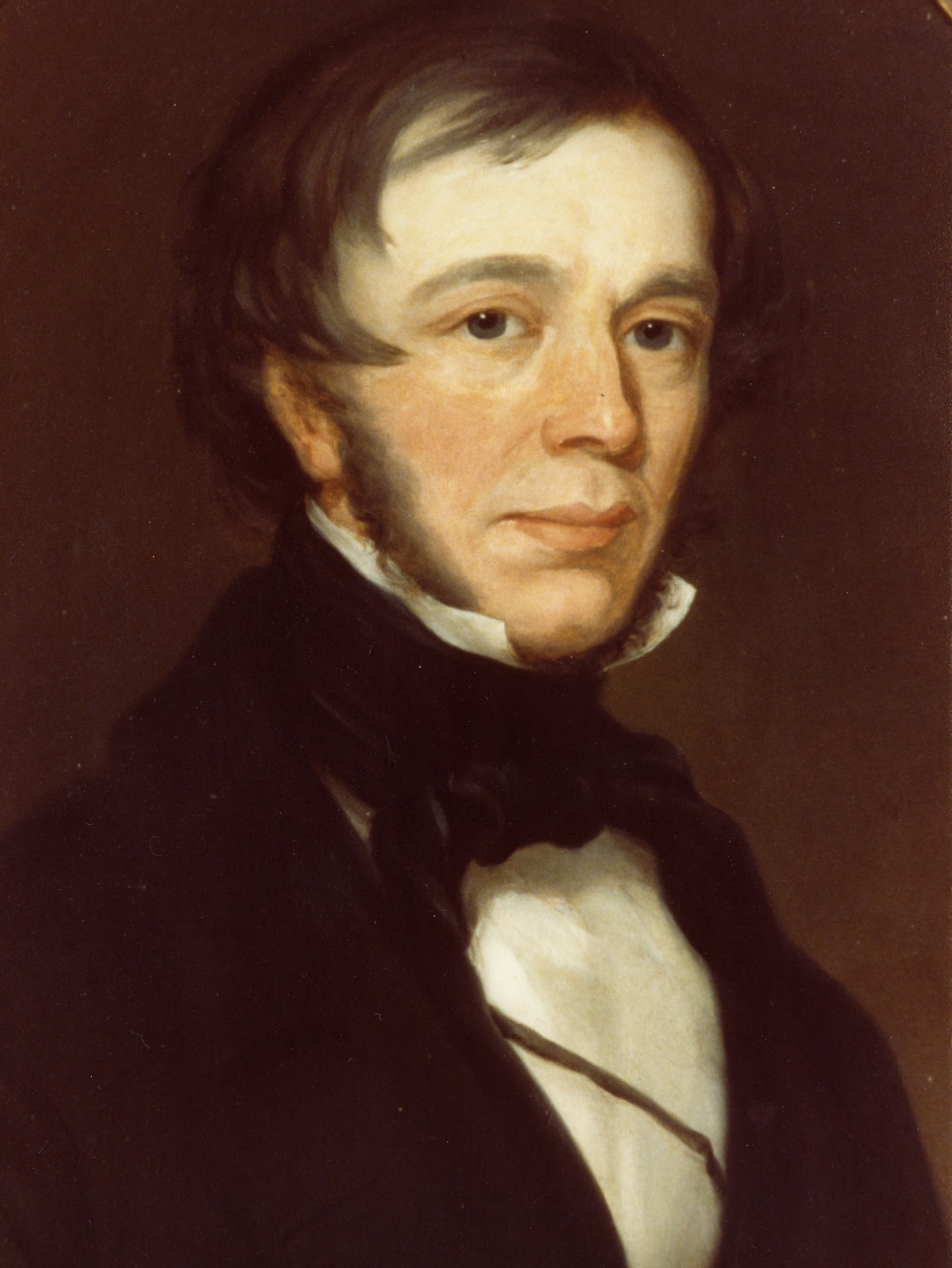
edwin.jpg
Portrait of Edwin A. Stevens
by Leah Loscutoff
Archivist & Special Collections Librarian

Every year on February 15th we honor the founding of Stevens Institute of Technology.  Edwin A. Stevens (1795 - 1868) was the youngest son of Colonel John Stevens and had a mind for engineering and business. He was the organizer and financier of the family.  He was described as having a “sober common-sense and strict attention to business.” His keen sense for business was one of the main reasons why Colonel John put Edwin in charge of managing his vast estate.

Edwin put more of his energy in business, but definitely was a talented engineer in his own right.  While still a young man he invented the Stevens plough, which was made and sold in large quantities under his patent.  In addition, he invented and patented in April of 1842 an airtight fire-room, an important feature found in warships of the Navy.

Martha.jpg
Portrait of Martha Bayard Stevens
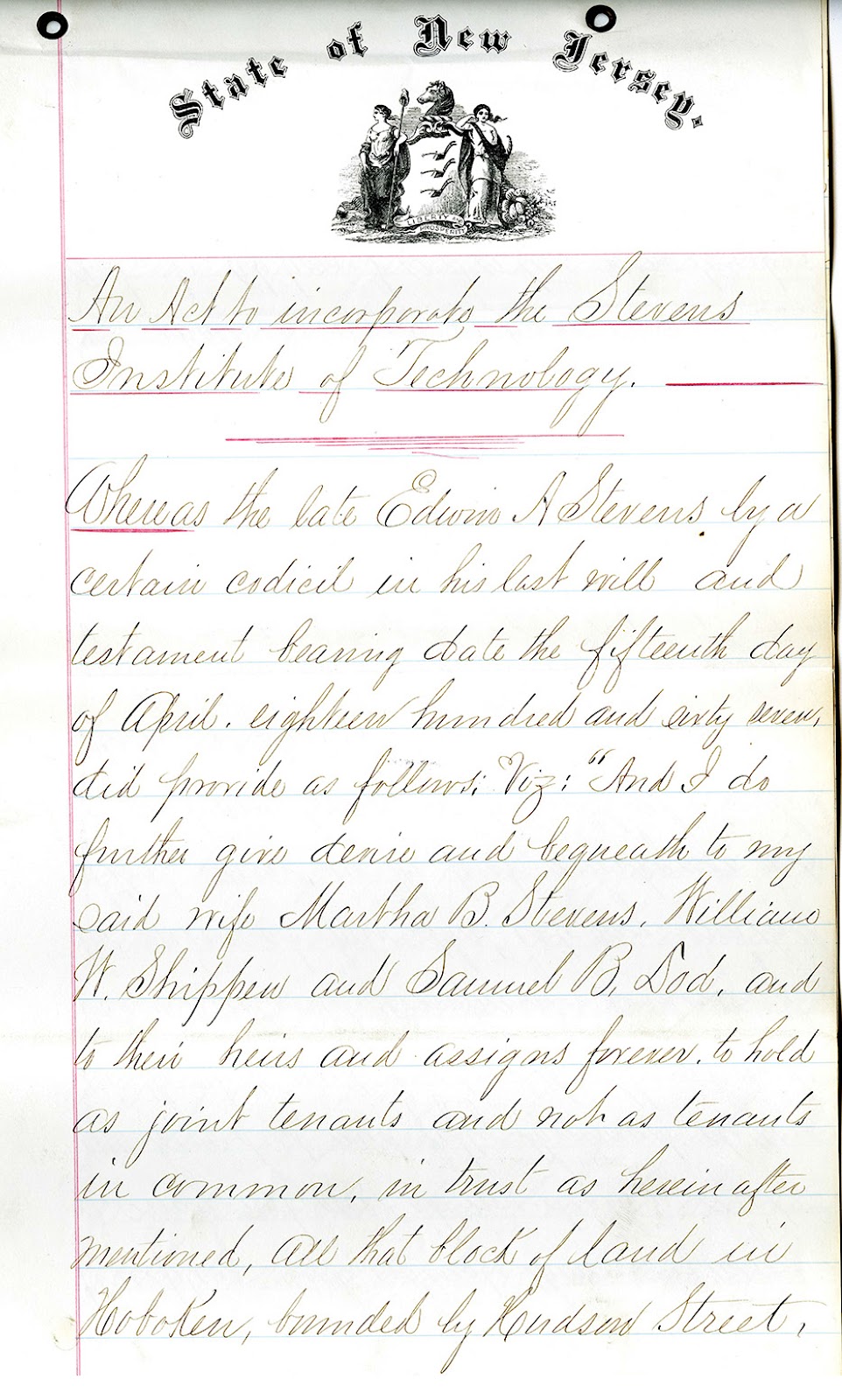
When Edwin passed away in 1868 he left money in his will to establish Stevens Institute of Technology, firmly anchoring the Stevens legacy in Hoboken. With the help of his widow, Martha Bayard Stevens, Stevens Institute of Technology was established in 1870.

Martha Bayard Stevens also served as one of the original board members at Stevens, ensuring that her late husband’s vision of an institute dedicated to advanced learning was followed through in a timely manner.

The Stevens Institute of Technology is America’s first college devoted to mechanical engineering. If it were not for Edwin A. Stevens’s foresight and Martha Bayard Stevens’ dedication, there would be no great permanent memorial such as Stevens Institute of Technology in Hoboken.

On past Founder’s Days we have celebrated by going out to the Stevens family plot at the Hoboken Cemetery. This the 146th anniversary of Stevens...only 4 more years until the big 150th anniversary!

SIT_act1870-1.jpg
Stevens Institute of Technology, Act of Incorporation, 1870.
Samuel C. Williams Library, Special Collections & Archives. 


Wednesday, December 9, 2015

The Stevens tradition of Cremating Calculus

by Leah Loscutoff, Archivist and Special Collection Librarian


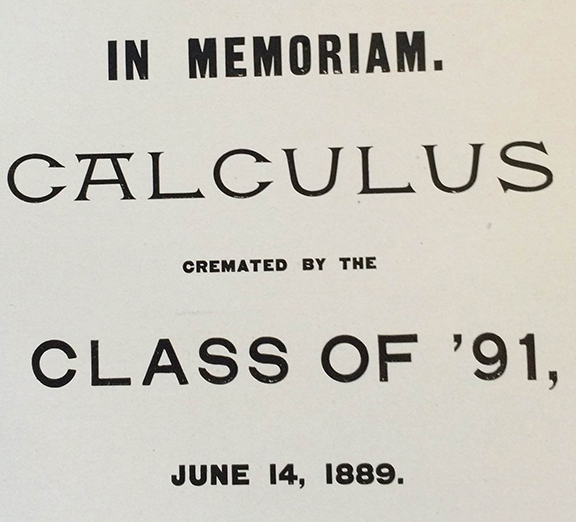
calculus.JPG
                                     Calculus Memoriam, Link yearbook 1890.
With finals coming soon and the fall semester in its final weeks, I’m reminded of one of Stevens’ more humorous traditions from the past, the “Cremation of Calculus.” The Cremation of Calculus was first started by Stevens students in 1889. This annual tradition of putting Calculus on trial stayed popular until the early 1960s. The exact date of when this beloved tradition ended can’t be clearly determined, but after 1961 it is difficult to find any mention of the Cremation of Calculus as a campus festivity. The premise was to put their most loathed class on trial, convicting it accordingly. The loathsome class that was unanimously despised by Stevens students was good old Calculus, often referred to as “Old Man Calculus”, “Charlie Calculus”, or just “Calc.”
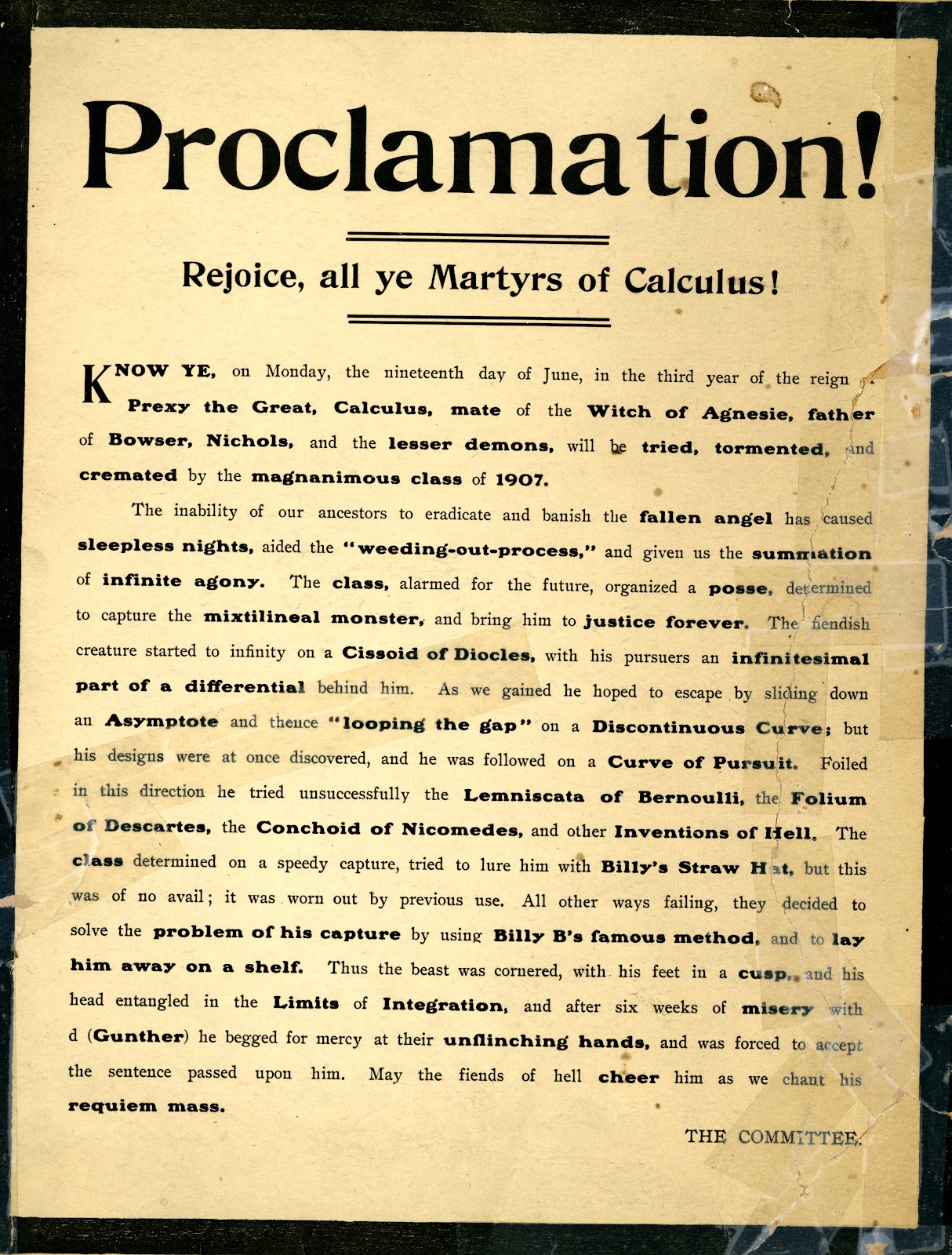
As stated in a Link yearbook from 1917, “the C.C.C (Calculus Cremation Committee) worked long and hard devising the most horrible death for Calculus.”  Below is one of the proclamations made by the committee in 1907.
Link1917420.jpg
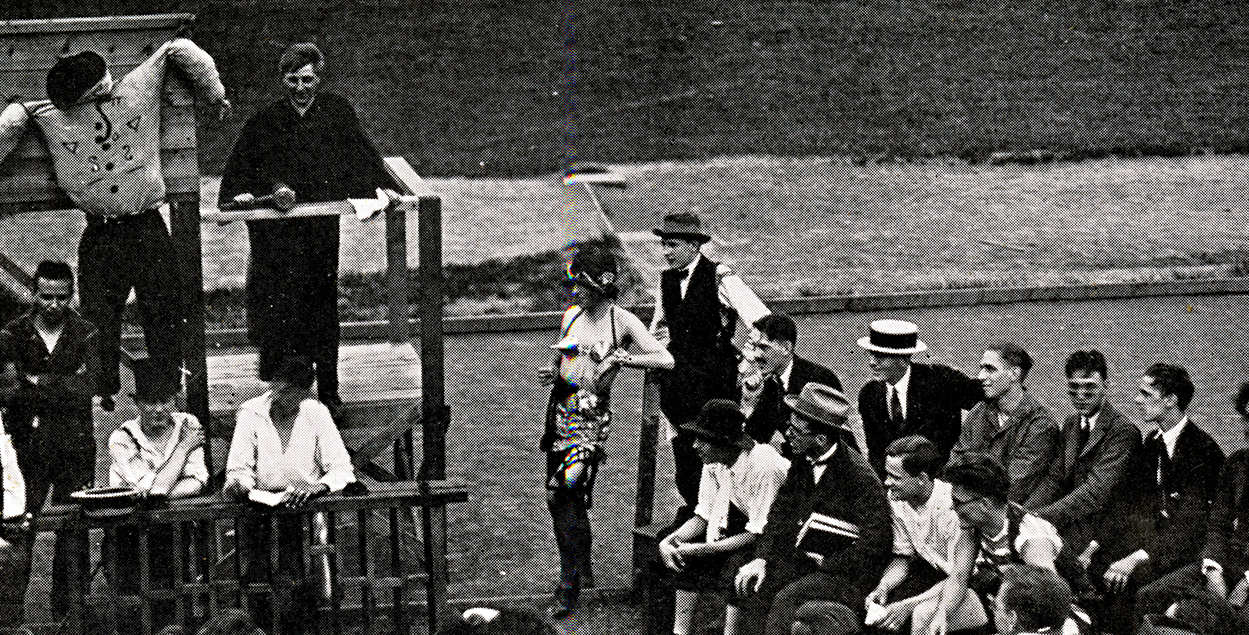
The case was tried in front of an audience, and there were even attorneys chosen to represent each side: the graduating class of that year versus Calculus. Faculty members were good sports during this annual custom, and prominent professors helped serve as jurors. Poor Calculus did not fare very well in these trials, and the judgment was always murder in the first degree. Calculus, the students’ wily and troublesome captive, was sent to its death on a yearly basis.  
Link1917416.jpg
Calculus Cremation Trial, Link yearbook 1924.  


During some years, a parade would ensue down Washington Street after the judgment was reached. The students would always burn an effigy of Calculus, dancing around the flames in celebration. In part this annual festivity was also a way for the students to vent out any frustrations from their strict courseload. The Cremation of Calculus always occurred at the end of the semester, when the hard work was completed and “Old Man Calculus” hopefully defeated.  

If you could put any class on trial today, which one would it be?  

Monday, September 21, 2015

Who is the link between Frederick W. Taylor and Batman?


by Scott Smith (scott.smith@stevens.edu)


Of the thousands of items in the Samuel C. Williams Library’s Frederick Winslow Taylor Collection, my hands-down favorite is the correspondence between Taylor and Scudder Klyce, whose 1921 book, Universe, influenced comic book writer Alan Grant’s creation of Anarky, an adversary of Batman.
Taylor and Klyce exchanged letters steadily between June 1911 and November 1914; however, the 65 pages of correspondence written between the two in June 1911, make for a fascinating look at both men’s views of scientific management as something more than a way of running a shop floor. Klyce’s first letter to Taylor, dated June 2, 1911, was written the same day that Klyce had attended a talk Taylor gave at the School of Marine Engineering in Philadelphia. Showing no lack of self-confidence, the 31-year-old Klyce, a Naval officer, began his letter, “Since hearing your talk this morning some comments have occurred to me which probably will be of interest to you, and which may be of value.” He then continued--for eight pages--to explain to Taylor why Taylor’s principles are correct and to outline his own theory of economics and the bonus system. The letter is a wonder of graphology: handwritten in ink, with words closely spaced; the lines slanting slightly up to the right. He concluded with, “This is all very condensed and I shall be glad to expand any of it which does not seem sufficiently proved,” followed by an offer to meet personally with Taylor to talk more. In short, it’s a letter that, not just by its content but also by its length, appearance, and the fact that it was written on the same day the writer had heard Taylor speak, hints at the personality behind the pen.
Taylor, because he had been traveling, didn’t receive the letter until June 6, when he promptly replied, “Your letter is intensely interesting to me, and I should especially appreciate the opportunity of making your acquaintance.” Klyce responded the same day, June 6, with a 12-page letter proclaiming scientific management as “the practical religion” that will, incidentally, “reform dogmatic science.” A few pages later, Klyce hints at his pursuit of the unifying philosophy that he will eventually describe in Universe:
I have been talking with a few scientists during the past week, as I have unified a few of their theories, and the narrowness of the scientist professor is pitiful; they define science as only that which can be put into a mathematical equation, and when I quoted experimental proof that the usual statement of the law of gravity was not absolutely accurate under any natural conditions and explained why, they could not controvert the proof but claimed that because the variation was so small that it could not be measured by science that it was not science.
And in a nine-page follow-up two days later to further outline his thinking on scientific management and religion, he writes:
Now, I have not written you the proof of this moral law; I have it poorly written down in about two hundred pages (emphasis mine), going at it from a scientific point of view. I haven’t found a scientist yet who would attack any part of this science, my statement of which is not conventional, and I have tried about a dozen.
Taylor’s subsequent responses to Klyce express appreciation for Klyce’s thinking about scientific management and encourage him to write up his ideas for publication in a national magazine, such as the Atlantic Monthly or the Century, with the suggestion that he “not go into such great detail that the ordinary readers will not have time to follow you.” In a 16-page letter written between June 14 and June 20, Klyce tells Taylor that he has started to write the article, and, in going over his ideas for the article he mentions his work on what will become Universe:
I know these various principles concerning scientific management because I have finished about the fourth or fifth revision of a book I am writing on handling men, which subject I have been studying systematically for some years…. This book first led me into a verbal statement of what all the vague mathematics of science really meant, and this led to a simple reduction of everything to terms of energy, whatever that may be--its nature is the unknown. I incidentally solved the Boyden problem--whether all rays of light travel with the same speed in space, the answer being no--for the Franklin Institute, and they are worrying over this solution; and I explained the mechanism of gravity, heat, light, and electricity, and the composition of matter, and eliminated the kinetic theory, and proved that the law of conservation of weight is wrong by experimentation and theoretical proof, and proved the total structure of the universe which I derived theoretically by the experimental evidence of star drift, and it can be understood by anyone; at least I think I have done this, and a number of scientists are trying to find out if I have….
He concludes this description with, “I am in a position to appreciate the value of your work, and I am very glad I can state some of the reasons fairly clearly. I can take the theory back just as far as anyone can follow, and then a little further--the limit is the unknown.”
Whether he was influenced by Klyce’s flattery--and Klyce claimed repeatedly that he didn’t intend to flatter--or whether he genuinely believed in Klyce’s work, Taylor encouraged Klyce. On June 26, he wrote a letter to Ray Stannard Baker, an influential journalist, in which he recommended Klyce as a writer, describing him as having, “remarkably sound ideas. He has analyzed our system in its philosophical relation much more thoroughly than anyone has done before. It seems to me that his analysis is sound.” That same day, he wrote to Klyce:
I have vaguely felt all along, when I was endeavoring to formulate the principles of scientific management, that I had not anywhere near “reached bottom,” and I feel now that your analytical mind and long years of honest thought in philosophical matters are just what is needed to tie up our practical results and the plain every-day formulae to the true fundamental theory.
There is room for any number of leaders in this movement, and after reading your letters with a great deal of care, it appears to me that you are just the man to lead in this more fundamental direction.
From this point, the correspondence between Klyce and Taylor focuses primarily on the article that Klyce is trying to write, with an eye on publishing it in the Atlantic Monthly magazine. In mid-July 1911, Klyce visited Taylor at Taylor’s mother-in-law’s home in Plymouth, Massachusetts. The two worked on revising the article, which Taylor described in a July 25 letter to Baker as being, “too deep for the every day reader.”
Klyce’s article was turned down by the Atlantic Monthly. In August, he suffered a nervous breakdown, and his wife, Etheldreda, revised the article, which was published under her name in the November 18, 1911, issue of The Outlook, a popular weekly magazine. Despite taking a leave of absence from his job and traveling to England to recover, Klyce was forced to retire from the Navy in 1912. He settled in Winchester, Massachusetts, where he continued to work on Universe and corresponded with many notable writers and philosophers of his time, including John Dewey and Upton Sinclair. Although Klyce and Taylor never met again after July 1911, they continued to write one another through 1914. These letters depict Klyce working on his book and expressing his continued praise for scientific management. Taylor died in March 1915. Six years later, Klyce published Universe, a book, he noted in the preface, that “unifies or qualitatively solves science, religion, and philosophy--basing everything on experimental, verifiable evidence.” He hadn’t forgotten Taylor, of whom he wrote:
Taylor’s doctrine of scientific management… is perhaps the most explicit and extensive advance in ethics or the science of living that has been made since Christ…. Taylor was a supremely great man. He was a democrat more beautifully balanced than Lincoln. (218)


Scudder Klyce was referenced as an influence to Batman nemesis, Anarky.


The legacy of Taylor will be explored this week at Stevens at the Taylor’s World Conference, held on campus, Thursday and Friday, September 24-25. If you would like to learn more about Taylor and his continued influence on modern life,  you may register to attend here: https://researchguides.stevens.edu/taylorsworld


Monday, November 3, 2014

International Education Month at SCW Library!


Full calendar of IEM events (click to expand)
In honor of International Education Month (based on International Education Week, promoted by the US Department of State’s Bureau of Educational and Cultural Affairs), the Library has put together an introduction to the many ways to greet students and scholars studying at Stevens from more than 60 different countries. International Education Month at Stevens is the product of the International Education Month Committee, under the auspices of the Office of International Programs.

https://blogger.googleusercontent.com/img/b/R29vZ2xl/AVvXsEhITE1HDdXfNHwUugrw6_4MqY2Wz6X_uGYBGQflAYTYuMNn6ZqU-Cem6fyCbN4rV6CjaPpoFIjyjgPZCJnmqq8S0T1SU85DhNC2lsTgpH_uBIP9EVKOeL4FsdObr88Elnn6jyDzLLw_pwQ/s640/Slide01.jpg
So stop by the Library to learn how to say hello to students from Cameroon to Yemen, Bulgaria to Venezuela.
Hola!
Bonjour!
Olá!
你好
السلام عليكم
---
Credits:
 
Maps:
All map images except Russia and Canada: Gingko Maps (http://www.ginkgomaps.com/)
The maps are licensed under the Creative Commons Attribution License and are distributed for free and without restrictions. All maps can be used, adapted and redistributed. The only required condition of the license is to cite and link to the GinkgoMaps project. 
Canada and Russia: Wikimedia (http://commons.wikimedia.org) 
These files are licensed under the Creative CommonsAttribution-Share Alike 2.5/3.0 Generic license. Images were recolored and resized; no other changes were made.
 
Translations: Omniglot (http://omniglot.com/) 
 
Original concept: Doris Oliver (doris.oliver@stevens.edu) 
Questions, comments or corrections can be directed to Vicky Ludas Orlofsky (victoria.orlofsky@stevens.edu)

Wednesday, October 8, 2014

Upcoming Events

Citation Management Tools
Wednesday, October 8, 2014 
3:00 pm to 4:00 pm, Library 204
Your bibliography begins as soon as you've cited an article, and assembling it is an ongoing part of your writing process. This session will cover the citation tools available to you, and how to make sure that your bibliography accurately reflects the work that went into it.

Issues in Scholarly Communication
Wednesday, October 22, 2014 
3:00 pm to 4:00 pm, Library 204
Scholarly communication refers to the many ways scholars communicate with each other, which include articles, conferences, blogs, Twitter, and much more. We'll discuss the latest news in scholarly publishing, open access, and other current events in the area of scholarly communication.

Undergraduate Senior Thesis Workshop
Wednesday, October 29, 2014 
12:00 pm to 1:00 pm, Library 204
For all students working on a senior thesis, this workshop will provide details about formatting & submission requirements.

Image Searching and Citation
Wednesday, October 29, 2014 
3:00 pm to 4:00 pm, Library 204
A research paper, presentation or poster looks extra special with nice graphics and photos. Luckily, the Internet has a plethora of images to save and use. But beware, visual media like words, carry copyright protections, sometimes specific instructions on use, and need to be cited. This workshop will introduce you to tools to find images on the Internet that are safe to use and how to cite them in your research.

Literature Reviews and Annotated Bibliographies
Wednesday, November 5, 2014 
3:00 pm to 4:00 pm, Library 204
This session will discuss how to assemble a comprehensive collection of pertinent references and how to turn those references into a clear narrative showing why your work is unique and important.

What's Your Impact: Citation Tracking
Wednesday, November 12, 2014 
3:00 pm to 4:00 pm, Library 204
Your impact as a scholar is partly reflected in the effect your work has on others, as observed through citations. This session will discuss the traditional methods to track how others are citing you through databases as well as "altmetrics," which measure impact in social media.

Grad Student Thesis/Dissertation Workshop
Wednesday, November 19, 2014 
3:00 pm to 4:00 pm, Library 204
For all students working on a thesis or dissertation, this workshop will provide details about formatting & submission requirements.

Tuesday, March 11, 2014

Martha Bayard Stevens: Building a School, City and Helping the Poor

by Leah Loscutoff, Archives and Special Collections Librarian and Special thanks to Doris Oliver, Assistant Curator, for her assistance with the research for this blog post.

March is women’s history month, and for this entire month staff at the Samuel C. Williams Library would like to honor some key women from the Stevens family, who played a big part in the development of Stevens Institute of Technology and in New Jersey.

Martha Bayard Dod Stevens 

Martha Bayard Dod Stevens was a Stevens family matriarch, philanthropist, and champion to the poor. After her husband Edwin A. Stevens passed away in 1868 she became instrumental in helping to establish Stevens Institute of Technology, which he initially founded.  Looking at Edwin A. Stevens’ Will you can determine that he left her with substantial authority over the Stevens family estate. This includes bequeathing the Castle Point homestead of 30 acres and the houses that were there under her control.  As one of the executors of the will, Martha insisted that the University be geared toward science and engineering.

Martha Bayard Dod Stevens was the daughter of Albert B. and Caroline (Bayard) Dod. Born in Princeton, New Jersey, May 15, 1831. She was a lineal descendant of the Bayard family, who escaped from France to Holland, and then made their way to America, settling in New Jersey prior to the Revolutionary War.  Her relative Colonel William Bayard owned the land which is now Hoboken and large tracts of land in Weehawken. Col. William Bayard subsequently fled the country after the surrender of the British and his property was confiscated by the Government.  The land of Hoboken was then purchased by Colonel John Stevens III in 1784, so that when Miss Dod became the wife of Edwin A. Stevens on August 22, 1854, she came into possession of property that had once been owned by a member of the Bayard family.  Martha and Edwin were married for 14 years, and were parents to seven children.

Having a strong interest in education, in the late 19th century she established the Industrial Education Association, a school for young women in Hoboken, and also, the Martha Institute for training boys in industrial skills. In addition, she provided the funding to construct the Hoboken free public library in 1896. She also founded St. Martha’s Ward in St Mary’s Hospital in Hoboken, and was a liberal contributor to St. Katherine’s Home, Christ Hospital, and every church in Hoboken regardless of denomination.

Mrs. Stevens was a well-known figure in Hoboken and contributed greatly not only to the establishment of the Stevens Institute of Technology but also to the town of Hoboken itself, a place that she loved dearly. Mrs. Stevens helped to establish the charity, Helping Hand club. This charity provided aid to poor women.  The club would meet once a week to sew and then were given the garments that were made, including coal and groceries. She made it a point to give what was left of her income annually to charity and would never invest in anything. Her last benefaction was to arrange for the erection of a recreational pier for the poor, this was known as the River Walk.

Mrs. Stevens built and endowed the Episcopal Church of the Holy Innocents, at Sixth Street and Willow
Episcopal Church of the Holy Innocents
Avenue, in memory of her daughter Julia, who died in Rome when a child. The church was also founded as a “free church” in the days when there were few. It was her intention that anyone would be able to worship there, regardless of social standing and wealth.

Mrs. Stevens died on April 1,1899 and the funeral was held at the Church of the Holy Innocents on April 4th.  She was beloved by the poor of Hoboken, who greatly mourned her death.


Monday, February 24, 2014

Stevens' Alum Worked To Better Living Conditions of Many

By Leah Loscutoff,
Archives & Special Collections Librarian

Special thanks to Doris Oliver, Assistant Curator, for her assistance with the research for this blog post.

This is the second article honoring Black History Month at Samuel C. Williams Library

In 1937, esteemed Stevens alumni James Sylvester Braxton graduated. That same year heavyweight boxing champion Joe Louis held his championship title, and the "Girl With the Honey-Coated Voice" jazz singer Nancy Wilson was born. Mr. Braxton was born on July 21, 1914, and lived on Wegman Parkway in Jersey City while attending Stevens.  

During his undergraduate days here he held a four-year Edgar B. Bacon scholarship and participated in numerous social and professional activities, which included involvement with the “Stute” and the Dramatic Society.  He was elected to the Tau Beta Pi fraternity and was also on the Dean’s list. He’s described in the 1936 Link yearbook as one of the most active members of his class. He was well known around campus and had a great academic record.

As described in a 1987 article in the Stevens Indicator, Braxton went off to have a successful career. He held positions as chief engineer for a general contracting firm and as instructor at Howard University in Washington D.C. He entered Harvard University in 1945 and was awarded a Julius Rosenwald Fellowship for graduate studies in regional planning. He earned the Master of City planning degree from Harvard Graduate School of Design.

After graduating from Harvard, Mr. Braxton moved into a new phase of his career. He was led by his lifelong passion to design and manufacture low-cost housing systems.  After working as site planner of international housing projects for the New York firm of Skidmore, Owings and Merrill and the International Basic Economy Housing Corporation, Mr. Braxton became supervising senior planner with the Chicago Housing Authority in 1950. In 1965, he assumed the position of assistant chief engineer with the Metropolitan Sanitary District of Greater Chicago. In 1981 Mr. Braxton left this position to become Vice President of Globetrotters Engineering Corporation. He continued his dream of producing reduced cost housing systems. As president of Braxton Inc., he has patented the Braxton Inc., which is a system of manufactured housing that can be assembled by unskilled labor with a minimum of training.

In 1987 Mr. Braxton returned to Stevens to receive an honorary degree and was quoted as saying:

“I have enjoyed being an engineer. It has both stimulated and satisfied my curiosity. My engineering training has enabled me to be more creative . . . Last year, I obtained a U.S. Patent on a systems approach to housing construction. Although the system will permit construction of any type building, anywhere, the shortage of affordable housing, and the presence of so many unemployed in the inner city make it an attractive starting place. For example, I would like to see pilot projects in Newark and Chicago. I believe that a properly-designed housing system such as the one I am developing, erected by semi skilled workers could cut the cost of decent housing by a factor of one third to one half.” 


Mr. Braxton accomplished much during his amazing career, and we would like to honor him this month of February, which is Black History Month. He spent his life’s work on bettering the conditions of his fellow man, and his ingenuity and determination is inspiring. Mr. Braxton will turn 100 years old this year, and still lives in the Chicago area.  

Friday, April 26, 2013

The Steam Engineering School and the Battle of Midway


By Scott Smith, Acquisitions and Collection Development Librarian

A bronze plaque on the Hudson Street side of the Lieb Building recognizes the structure’s being the site of the United States Navy Steam Engineering School. The school, designed to train Navy officers for World War I and staffed entirely with Stevens faculty, opened in 1918 and closed in 1919. 

Lieb Building was constructed by the Navy specifically to house the school and was sold to Stevens after the school closed.  Among the graduates of the Steam Engineering School was an officer who played a key role in the United States’ outwitting the Japanese navy in the World War II Battle of Midway. Joe Rochefort, who had joined the Navy straight out of high school
in 1917, enrolled in the Steam Engineering School at Stevens in 1918. Several years after his training there, Rochefort took a Navy cryptanalysis class. Subsequently, he joined the Navy intelligence department, where he learned Japanese and developed his cryptology skills.

When the U.S. entered World War II after the attack on Pearl Harbor, Rochefort was the Officer in Charge of the Hawaiian intelligence station. His team of analysts, working with British and Dutch codebreakers, helped crack the Japanese navy’s main fleet cipher. This intelligence work revealed plans for an upcoming attack; however, opinions differed concerning where it would take place: some thought the Aleutian Islands, others thought Papua New Guinea, still others thought the west coast of the United States. Rochefort was convinced that it was Midway Atoll.

One of Rochefort’s staff members had an idea to send an unencrypted message with the information that Midway was having troubles with its desalination equipment. As hoped, the Japanese navy intercepted the message, and when the U.S. Navy intercepted and decoded a Japanese message calling for an increase in desalination supplies, they knew that Midway was the target. Further work by Rochefort’s team determined the date of the attack as either June 4 or June 5, 1942. Japan had lost its advantage, and the ensuing U.S. victory at Midway cost Japan its naval supremacy in the Pacific for the remainder of the war.

Two books in the Stevens library tell the story of Midway and Joe Rochefort: