Showing posts with label stevens. Show all posts

Wednesday, October 8, 2014

Upcoming Events

Citation Management Tools
Wednesday, October 8, 2014 
3:00 pm to 4:00 pm, Library 204
Your bibliography begins as soon as you've cited an article, and assembling it is an ongoing part of your writing process. This session will cover the citation tools available to you, and how to make sure that your bibliography accurately reflects the work that went into it.

Issues in Scholarly Communication
Wednesday, October 22, 2014 
3:00 pm to 4:00 pm, Library 204
Scholarly communication refers to the many ways scholars communicate with each other, which include articles, conferences, blogs, Twitter, and much more. We'll discuss the latest news in scholarly publishing, open access, and other current events in the area of scholarly communication.

Undergraduate Senior Thesis Workshop
Wednesday, October 29, 2014 
12:00 pm to 1:00 pm, Library 204
For all students working on a senior thesis, this workshop will provide details about formatting & submission requirements.

Image Searching and Citation
Wednesday, October 29, 2014 
3:00 pm to 4:00 pm, Library 204
A research paper, presentation or poster looks extra special with nice graphics and photos. Luckily, the Internet has a plethora of images to save and use. But beware, visual media like words, carry copyright protections, sometimes specific instructions on use, and need to be cited. This workshop will introduce you to tools to find images on the Internet that are safe to use and how to cite them in your research.

Literature Reviews and Annotated Bibliographies
Wednesday, November 5, 2014 
3:00 pm to 4:00 pm, Library 204
This session will discuss how to assemble a comprehensive collection of pertinent references and how to turn those references into a clear narrative showing why your work is unique and important.

What's Your Impact: Citation Tracking
Wednesday, November 12, 2014 
3:00 pm to 4:00 pm, Library 204
Your impact as a scholar is partly reflected in the effect your work has on others, as observed through citations. This session will discuss the traditional methods to track how others are citing you through databases as well as "altmetrics," which measure impact in social media.

Grad Student Thesis/Dissertation Workshop
Wednesday, November 19, 2014 
3:00 pm to 4:00 pm, Library 204
For all students working on a thesis or dissertation, this workshop will provide details about formatting & submission requirements.

Friday, March 28, 2014

Millicent Fenwick: A Woman with Fearless Character

by Leah Loscutoff, Archives and Special Collections Librarian and Special thanks to Doris Oliver, Assistant Curator, for her assistance with the research for this blog post

Millicent Fenwick speaking at technology
hall dinner,  June 1982.
Millicent Vernon Hammond Fenwick was born February 25, 1910, in New York City, and passed away September 16, 1992 at the age of 82.  She was born 10 years before women gained the right to vote, and the same year a voting machine was actually patented to restrict women’s votes. Millicent Fenwick would become a political force to be reckoned with, but politics wouldn’t become a part of her life until later on. She was a colorful character with a lot of personality. She even influenced Garry Trudeau’s cartoon character Lacey Davenport in Doonesbury.

Millicent was the daughter of a prominent family. Her father, Ogden H. Hammond, was a financier and state legislator and her mother was Mary Picton Stevens Hammond. When Mrs. Fenwick was 5, her mother, Mary Stevens, drowned when a German submarine sank the ocean liner Lusitania. Millicent was the great granddaughter of Edwin A. Stevens and Martha Bayard Dod Stevens, the founder of the Stevens Institute of Technology.

Millicent never received a high school diploma or college degree, but she studied philosophy under Bertrand Russell at the New School and spent time as a fashion model for Harper’s Bazaar. She was fluent in Italian, French, and Spanish. As a young woman, she fell in love with a married businessman, Hugh Fenwick. In June 1932, she married Hugh and together they operated a 100-acre chicken and dairy farm. The farm was financially disastrous, and her husband left her for a job abroad and they separated in 1938. After her husband left, she had to find work and support her two children on her own. Refusing money from her family, she scraped by on her own. A divorce with Hugh was finalized in 1945.

Without a high school diploma it was hard for her to secure anything, but in a stroke of luck she had two short stories published which led her to a job at Vogue magazine. She worked at Vogue as a feature writer from 1938-1952.  She inherited a fortune when her father died in 1956 but remained frugal, counting her change from coffee, using one lamp to work by and driving a Chevrolet in a community of luxury vehicles.

Millicent Fenwick outside of Morton on River St., circa 1982.
Millicent first became interested in politics because of the plight of African Americans in America, and also the oppressive Nazi government in Germany. When she got into politics, she became an advocate for a variety of issues. Some of these issues include, Civil Rights, peace in Vietnam, help for the poor, prison reform, gun control, and urban renewal.  One of her proudest achievements was being a lead sponsor of the resolution creating the commission to monitor the 1975 Helsinki accords on human rights. Millicent’s political career started later on in life.

She first ran and won a seat in the State Legislature at the age of 59 and in Congress at 64. The Congressional primary rival she beat was Thomas H. Kean, later elected Governor of New Jersey. Her Congressional tenure ended in 1982, when she ran for the United States Senate and lost narrowly to Frank R. Lautenberg, a Democratic millionaire whose big-spending campaign portrayed her as too eccentric. Millicent herself refused to take any political-action committee money.  After her loss, President Ronald Reagan appointed her as the first American envoy to the United Nations Food and Agriculture Organization in Rome. She retired from that post in 1987.  Throughout her career she was an advocate for ending world hunger, and supported the food stamps program here in America. Although a Republican, she often found herself voting against her party’s agenda. She was fiscally conservative, but socially very progressive.
Millicent Fenwick and Carmine Di Pietro (Stevens class of 39')
at the technology hall dinner, June 1982.

Known for her pipe smoking and her outspoken stylish manner, she was often described as the Katherine Hepburn of politics. She was witty, fearless, elegant, and known for speaking her mind. She so frustrated Representative Wayne Hays, a Democrat from Ohio, that he once threatened to withhold her staff’s paychecks “if that woman doesn’t sit down and keep quiet,” but as the saying goes, well-behaved women seldom make history.  Millicent once said,  “I learned the most important thing in life is character.”  Character is definitely something that she never lacked.

Monday, February 24, 2014

Stevens' Alum Worked To Better Living Conditions of Many

By Leah Loscutoff,
Archives & Special Collections Librarian

Special thanks to Doris Oliver, Assistant Curator, for her assistance with the research for this blog post.

This is the second article honoring Black History Month at Samuel C. Williams Library

In 1937, esteemed Stevens alumni James Sylvester Braxton graduated. That same year heavyweight boxing champion Joe Louis held his championship title, and the "Girl With the Honey-Coated Voice" jazz singer Nancy Wilson was born. Mr. Braxton was born on July 21, 1914, and lived on Wegman Parkway in Jersey City while attending Stevens.  

During his undergraduate days here he held a four-year Edgar B. Bacon scholarship and participated in numerous social and professional activities, which included involvement with the “Stute” and the Dramatic Society.  He was elected to the Tau Beta Pi fraternity and was also on the Dean’s list. He’s described in the 1936 Link yearbook as one of the most active members of his class. He was well known around campus and had a great academic record.

As described in a 1987 article in the Stevens Indicator, Braxton went off to have a successful career. He held positions as chief engineer for a general contracting firm and as instructor at Howard University in Washington D.C. He entered Harvard University in 1945 and was awarded a Julius Rosenwald Fellowship for graduate studies in regional planning. He earned the Master of City planning degree from Harvard Graduate School of Design.

After graduating from Harvard, Mr. Braxton moved into a new phase of his career. He was led by his lifelong passion to design and manufacture low-cost housing systems.  After working as site planner of international housing projects for the New York firm of Skidmore, Owings and Merrill and the International Basic Economy Housing Corporation, Mr. Braxton became supervising senior planner with the Chicago Housing Authority in 1950. In 1965, he assumed the position of assistant chief engineer with the Metropolitan Sanitary District of Greater Chicago. In 1981 Mr. Braxton left this position to become Vice President of Globetrotters Engineering Corporation. He continued his dream of producing reduced cost housing systems. As president of Braxton Inc., he has patented the Braxton Inc., which is a system of manufactured housing that can be assembled by unskilled labor with a minimum of training.

In 1987 Mr. Braxton returned to Stevens to receive an honorary degree and was quoted as saying:

“I have enjoyed being an engineer. It has both stimulated and satisfied my curiosity. My engineering training has enabled me to be more creative . . . Last year, I obtained a U.S. Patent on a systems approach to housing construction. Although the system will permit construction of any type building, anywhere, the shortage of affordable housing, and the presence of so many unemployed in the inner city make it an attractive starting place. For example, I would like to see pilot projects in Newark and Chicago. I believe that a properly-designed housing system such as the one I am developing, erected by semi skilled workers could cut the cost of decent housing by a factor of one third to one half.” 


Mr. Braxton accomplished much during his amazing career, and we would like to honor him this month of February, which is Black History Month. He spent his life’s work on bettering the conditions of his fellow man, and his ingenuity and determination is inspiring. Mr. Braxton will turn 100 years old this year, and still lives in the Chicago area.  

Wednesday, February 12, 2014

Honoring Black History Month at SC Williams Library

Randolph Montrose Smith seated in the third row with
graduating class of 1924 in front of the EAS Building.

By Leah Loscutoff,
Archives & Special Collections Librarian

Special thanks to Doris Oliver, Assistant Curator, for her assistance with the research for this blog post.

Since 1976, the month of February has been officially designated as Black History Month.

In the year of 1924, DeHart Hubbard was the first African American to receive an individual Olympic medal for the long jump. That same year Shirley Chisholm was born in Brooklyn, New York. She went on to become the first African-American woman elected to Congress in 1969.

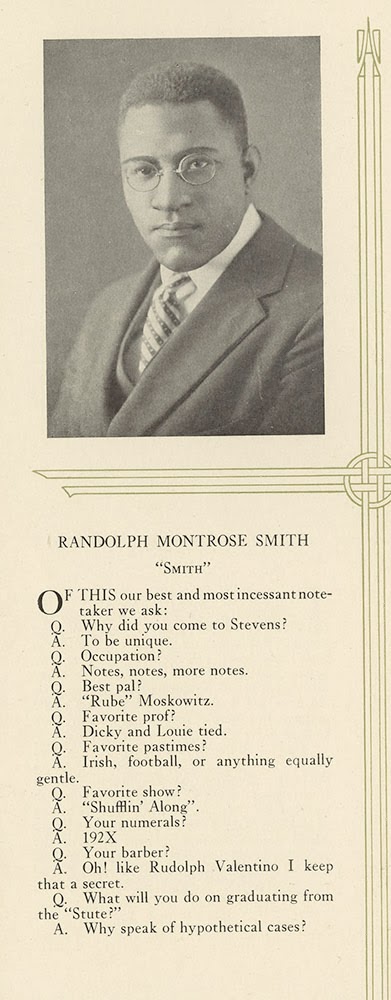
Also in 1924, the first African-American student graduated from Stevens Institute of Technology. Randolph Montrose Smith was born in Barbados in 1901. He was just two years old when he arrived in New York City in 1903 on a ship named the Cearense. Unfortunately, not too much is known about Randolph, but we do know that he lived in upper Manhattan on West 140th Street while attending Stevens.

Searching the 1930 census records we also learned that he was working as a Civil Engineer for the Manhattan subway system after he graduated from Stevens, an excellent job opportunity for Civil Engineers at that time! Stevens Institute of Technology also created a scholarship in his name to which undergraduate students may apply.

Smith's picture in the year book, The Link
Black History Month is a time to recognize the central role and achievements of African Americans in U.S. history and in our local communities.  Stevens Institute of Technology is committed to diversity here on campus, and to celebrate Black History Month, the library wants to briefly highlight some of Stevens accomplishments by African-American alumni throughout the month. We will be posting more about the accomplishment of African Americans and Stevens during the month of February.


Wednesday, October 16, 2013

1st Decade of Women at Stevens -An Interview with Alum Eleni Coyle


Pictures of Eleni Coyle, her husband Jim Coyle, her roommate, and friends.

Part 2 of Ada's Legacy Series. This Friday the College of Arts and Letters will be hosting a conference, "An interdisciplinary Conference Celebrating the Achievements and Legacies of Ada Lovelace". The Library wants to celebrate the legacy of Ada Lovelace by posting blogs by Stevens Students written during Professor Lee Vinsel's, History of Stevens course last semester about the history of women at Stevens. The students researched the library's special collections to discover pictures and information about this important time.


By Dana Lyons & Devin Corson, Class of '13
               
 As women at Stevens in the new millennium, it would be really interesting to find out what life at Stevens was like in the very first decade women entered.  Eleni Coyle entered the Stevens community in 1979 and graduated in 1983 with her Bachelors and Masters in Chemical Engineering.  She was able to give us some perspective on the end of this first decade of women at Stevens.

The journey of being a woman at Stevens begins before freshman year—the women must be brought up strong and confident.  In Eleni’s case, her father was the role model in her life that made it possible to earn her degree.  Reflecting upon her fond memories Eleni notes, “When I was a teenager he had instilled in me that I could have the same career goals as my brothers, if I wanted to, and that a good career is fundamental to a secure future.  He had instilled a love of math to me and he had also brought me with him to various factories where I became curious as to the operation of machinery etc., leading me to study engineering.”

The professors at Stevens welcomed the idea of women attending with open arms, as far as Eleni could tell.  With a bit of a smirk she stated, “My professors were fair minded people.  Having said that, I will never forget the rare exception to my previous statement, where even though I was sitting in the front row, a certain professor insisted in greeting the class as "Hello gentlemen".  I heard that he later transferred to NJIT :)” Eleni was offered the position of Head Physics proctor, and later when she was studying for her masters at Stevens she received a Fellowship from the Plastics Institute of America.

The class sizes were smaller then, and the women in each were definitely in short supply.  She mentioned that there were only 5 women who graduated with her in the Chemical Engineering department in ’83.  However, she and the women around her did not feel hindered in any way due to their gender.  They felt like they could do anything.  Even as few as they were they made their presence known and made a huge splash both in and out of the classroom by joining extracurricular activates.  Eleni even cofounded the Philosophy Club. Eleni went on to work at various companies doing chemical engineering, but eventually found her passion teaching high school seniors Chemistry and Physics.

To wrap up her feelings about her stay at Stevens she said, “My overall experience at Stevens was outstanding and that is why I was very happy when three of my four sons decided to attend Stevens.  Academically it prepared me with a rigorous curriculum. It empowered me to know that I could handle any job.  Personally, I met my husband there so that was an added perk :)” Side note: she and her husband were freshman chemistry lab partners.  We will leave you to enjoy how ironic and the endearing that fact is.

Tuesday, October 15, 2013

Ada's Legacy: Women at Stevens

This Friday the College of Arts and Letters will be hosting a conference, "An interdisciplinary Conference Celebrating the Achievements and Legacies of Ada Lovelace". The Library wants to celebrate the legacy of Ada Lovelace by posting blogs by Stevens Students written during Professor Lee Vinsel's, History of Stevens course last semester about the history of women at Stevens.

By Dana Lyons & Devin Corson, Class of '13

Overview of Women at Stevens
This series of entries is intended to tell the reader a story about what it was like to be a woman at Stevens over the last four decades.  It will showcase the experiences of four incredible women, one from each decade, intermingled with key implementations focused on women at Stevens. 
Stevens was one of the last engineering schools to begin accepting women into the student body.  All female applicants would receive what was called a “no tomato” letter from the Stevens admissions office, sarcastically declining their admission.   The 1971 the Stevens Indicator released the results of a poll taken before the co-ed change that showed a high majority of students favored having female undergraduates on campus.  Out of 861 responses, 651 said yes, 179 said no, and 31 had no opinion.  Sure enough in 1971, 19 females were admitted into the incoming class of 387 members.  Lenore Schupack (below) entered Stevens with this first female class, earned her degree in just three years, and became the first female to graduate in 1974. 

The women were housed on the third floor of the “relatively luxurious” dormitories called the Married Student Apartments (now the Castle Point Apartments).  When asked by administrators if they wanted to be segregated or randomly mixed among the men, the women opted to be equals and were scattered into the same classes, overwhelmingly outnumbered by men.  By 1974, the women’s fencing team was in full swing, being the first women’s Varsity team at Stevens that was also coached by the Duck’s first female coach, Linda Uallhammer. 

In 1977, the Office of Special Programs for Women was implemented, which worked to increase the numbers of young women in pursuing careers in engineering and science.  This office presented several major programs to the women in the Stevens community, including the Society of Women Engineers chapter; residential Women in Engineering Summer Program for high school women; Women in Engineering Symposia for students, teachers, and administrators; and the Women in Engineering Network for young women considering careers in engineering.  The first national sorority, Phi Sigma Sigma, came to Stevens in 1982, followed by the second national sorority at Stevens, Delta Phi Epsilon, in 1985. Soon afterwards a local sorority, Omicron Pi, was formed and eventually become the third and final national sorority at Stevens, Theta Phi Alpha.   Read along with us as we trace the journey of a few strong and influential women at Stevens throughout the decades.