Showing posts with label databases. Show all posts

Wednesday, November 11, 2015

New York Times Historical: Database Highlight

by Courtney Walsh
In my previous blog post about the recently released movie The Walk, I used several databases to retrieve information about the infamous protagonist of that movie, Philippe Petit. I enjoyed finding out what books he has authored and what others have written about him, but his story really came to life when I realized that I could easily retrieve information from the Library’s subscription to the New York Times Historical database.  Using this database, I was able to see the front page of the New York Times as it appeared on August 8, 1974, the day after his high wire-walk between the two towers of the World Trade Center.
As we all know, access to the New York Times online is limited by whether or not we are subscribers. Without a subscription, we can only access a certain number of articles per month for free. Additionally, free access goes back only as far as 1987. Some articles are available for free between 1851-1922 while articles between 1923-1986 are available for purchase.
Here at Stevens, the Library subscribes to the daily print version of the New York Times (you can request it at the Circulation Desk). For research purposes, however, you may find that electronic access is preferable due to the ease of the search capabilities that are embedded in its design. We have access to the current daily New York Times electronically via two databases, LexisNexis and ProQuest. Our subscription to New York Times Historical within ProQuest allows us to view the paper as far back as 1851.
Stop and think about that for a moment! We can literally look back in time using New York Times Historical. Scholars usually utilize a combination of primary, secondary, and tertiary sources when conducting research. Depending on the context of the research, newspapers may be considered either primary or secondary resources. An article about the Civil Rights Movement could be considered a primary source if it was written during the Movement itself, or a secondary source if it was written more recently with a more analytical or interpretive angle. For an excellent summary of the differences between primary, secondary, and tertiary sources, see this useful website from Ithaca College Library. For an excellent overview of the ways in which newspapers can be used for historical research, please see “Newspapers”, by Anne Rubenstein (York University), published on the website of the Center for History and New Media at George Mason University.
When you are feeling inspired to research the people, events and ideas that you’re learning about in class, have read about, or seen depicted in movies, open up New York Times Historical, available in our Databases A-Z list (you’ll need to log in via myStevens if you are off-campus).
Once you have the database open, you have a variety of options in which to construct your search. As with all databases, there are some useful tips that can help as you start to locate information:

Keyword searching

Brainstorm a variety of keywords related to your search. Include synonyms and remember that the terms that we use now may not have been used during the time they occurred (e.g. World War I). Review other keywords, phrases and any other important information that appears in the article. Add them to a working list of terms that you can use to further expand or narrow your search.

Phrase searching

Put phrases in quotes to ensure you find the terms together in the document (e.g. “Hillary Clinton”, “Stevens Institute of Technology”, “artificial intelligence”)

Boolean searching

Boolean operators (AND OR NOT) are built in to the advanced search mode of New York Times Historical. Use these terms to connect your search terms rather than searching a long string of words (e.g. “Bill Gates AND philanthropy”, “mechanical engineering” OR “electrical engineering”, apple NOT fruit)

Wildcard searching

Brainstorm all the iterations of your keywords and search terms. Use wildcards to search all terms at once (e.g. psycholog* searches psychology, psychologist, psychologists, psychological).
Most databases offer simple ways to refine or limit your searches so it’s also useful to review the options available in New York Times Historical:
Basic Search


Screenshot from New York Times Historical database (ProQuest)

Advanced Search (add rows and use Boolean operators as needed to refine or narrow your search):


Screenshot from New York Times Historical database (ProQuest)
Publication Date (search on, before, or after specific dates or a within a range of dates):
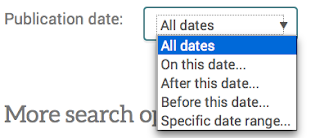


Screenshot from New York Times Historical database (ProQuest)

Document Type (e.g. articles, classified ads, comics, editorials, obituaries, etc. ):


Screenshot from New York Times Historical database (ProQuest)
Below are some screenshots of articles and images about notable events that are available via New York Times Historical:
An article about the Beatles published January 4, 1964, the day after their first appearance on American television:


An article published the day after Dr. Martin Luther King Jr. was assassinated:


Screenshot from New York Times Historical database (ProQuest)
An excerpt of an editorial article published April 15, 1865, the day after President Abraham Lincoln was assassinated:


Screenshot from New York Times Historical database (ProQuest)
The wealth of information about our world that is available through New York Times Historical is staggering. I hope that this short piece about one of our unique databases has inspired you to visit the New York Times Historical database to investigate the person or subject of your choosing! What will you look up?
A note about citation: Like all ProQuest databases, tools for a number of citation styles (APA, MLA, Chicago, Turabian, among many others) are provided to help you construct appropriate citations. In using screenshots of articles from the database above please note that I have provided an informal citation showing the source of the images (screenshots that I created myself). The works contained within the New York Times Historical database are copyrighted, even those articles that are outside of standard copyright protection. Fair use for educational purposes is allowed, but proper citation is a must. For more information on citing images, please visit our How to Cite Your Sources research guide.

Sunday, September 2, 2012

Fall Workshops @ the Library

This fall's workshops include topics such as: professional social networking, RefWorks, citation searching and bibliometrics, and online research for Graduate and WebCampus students. View the full schedule, descriptions and sign up @ http://scwlibrary.eventbrite.com.

Tuesday, September 13, 2011

JSTOR releases free early journal content

JSTOR announced last week that they would be releasing all their pre-1923 journals for free. This includes almost half a million articles from over 200 journals. The content is being released gradually, starting this week, and will be accessible alongside our three current JSTOR collections (Arts and Sciences I & II + Math and Statistics) via http://ezproxy.stevens.edu/login?url=http://www.jstor.org. You can also browse the list of newly available content by discipline or by title.

Friday, September 9, 2011

Database Access Issues

We are experiencing some server issues, causing some of our databases to load slowly, or be temporarily unavailable. If you are having problems accessing any of our online resources, please report it @ http://www.stevens.edu/helpdesk

Friday, October 1, 2010

American Chemical Society Journals

The library is happy to announce that the Stevens community now has online access to the journals of the American Chemical Society. Our subscription includes all years, from Vol. 1, Issue 1 to the present.

Journals included in this collection are:
  • Accounts of Chemical Research
  • ACS Applied Materials & Interfaces
  • ACS Catalysis (available in 2011)
  • ACS Chemical Biology
  • ACS Chemical Neuroscience
  • ACS Combinatorial Science (previously called Journal of Combinatorial Chemistry)
  • ACS Medicinal Chemistry Letters
  • ACS Nano
  • Analytical Chemistry
  • Biochemistry
  • Bioconjugate Chemistry
  • Biomacromolecules
  • Chemical Research in Toxicology
  • Chemical Reviews
  • Chemistry of Materials
  • Crystal Growth & Design
  • Energy & Fuels
  • Environmental Science & Technology
  • Industrial & Engineering Chemistry Research
  • Inorganic Chemistry
  • Journal of Agricultural and Food Chemistry
  • The Journal of the American Chemical Society
  • Journal of Chemical & Engineering Data
  • Journal of Chemical Information and Modeling
  • Journal of Chemical Theory and Computation
  • Journal of Medicinal Chemistry
  • Journal of Natural Products
  • The Journal of Organic Chemistry
  • The Journal of Physical Chemistry A/B/C
  • The Journal of Physical Chemistry Letters
  • Journal of Proteome Research
  • Langmuir
  • Macromolecules
  • Molecular Pharmaceutics
  • Nano Letters
  • Organic Letters
  • Organic Process Research & Development
  • Organometallics
As with our other online resources, you can bookmark the direct link here (http://ezproxy.stevens.edu/login?url=http://pubs.acs.org/action/showPublications?display=journals)
or access it through our online resources page (http://www.stevens.edu/library/research/azlist.html).

Thursday, September 9, 2010

JSTOR & RefWorks now available!

The library is happy to announce two new online tools for your research: JSTOR and Refworks.

JSTOR is a multi-disciplinary full-text database of scholarly journals, and will be especially helpful for those doing research in the humanities and social sciences. For more information on JSTOR, see: http://about.jstor.org/

RefWorks is an online citation manager, which allows you to export,
sort, edit and share references from many online sources, as well as create bibliographies in a variety of formats, all from a web-based portal. (Note: to use this tool, you will have to sign up for an individual account.) For more information on RefWorks, see: http://www.refworks-cos.com/about/

Off-campus users must access JSTOR and RefWorks through the library's online resources list, or use the following links:

Tuesday, September 7, 2010

Springer Materials Free Trial

Now till Oct 29th, the library has trial access to the Springer Materials, the world's largest resource for physical & chemical data in materials science.

The details:
  • Based on Landolt-Börnstein, the unique and top-quality data collection in all areas of physical sciences and engineering
  • Includes 165,000 substances and material systems, 3,000 properties and 1,000,000 literature citations.
  • User friendly one-stop web platform
  • International experts scan the primary literature in more than 1000 peer-reviewed journals and evaluate and pre-select the most reliable and scientifically acknowledged data.
  • Researchers save time as they do not need to scan and assess primary literature themselves.
The link:

-OR-
Find it on our Online Resource List

Tuesday, August 17, 2010

A New Tool to Support Your Work in Optics and Photonics


The library has recently acquired access to SPIE eBooks on the SPIE Digital Library. SPIE eBooks includes 120 significant titles from SPIE Press, including Field Guides, monographs and reference books, and Tutorial Texts in the field of optics and photonics, an area which encompasses multiple disciplines.

SPIE is one of the world’s foremost non-profit societies in the field of light research, publishing more than 17,000 new articles and conference proceedings each year as well as 15 to 20 books.
The areas covered in the SPIE Digital Library and SPIE eBooks include:
  • Astronomy & Astronomical Optics
  • Biomedical Optics and Imaging
  • Communication and Information Technologies
  • Defense and Industrial Sensing
  • Electronic Imaging and Processing
  • Micro- and Nano- Technologies
  • Optics and Electro-Optics
We hope you find SPIE eBooks becomes an essential tool in your work; the library and SPIE would value your feedback. (You can always contact us at: library [at] stevens [dot] edu.)

Wednesday, June 16, 2010

System downtime

This Saturday, 6/19, from 7:00am to 12:00pm, Information Technology will be performing required maintenance on the network file storage system. Services that will experience outages during the maintenance timeframe include Stevens E-mail, individual, departmental and shared file services, and Stevens website content. Additionally, the following applications will be disrupted:

Physical Plant work order system, password self-services, CallPilot web services, library proxy services, Adina, LabView, & Ansys license managers, and Webevents.

This means that all library online resources will only be available from on-campus during that time.

If you have any questions or concerns, please contact the Information Technology help desk at 201-216-5500 or go to www.stevens.edu/helpdesk.

Wednesday, April 14, 2010

Scopus Lunch & Learn

Please join us for the Scopus Lunch & Learn at the library on Wednesday, April 21, from noon to 1 pm.

Lunch will be provided, so please let us know if you plan to attend. (Please also let us know if you require a vegetarian meal.) RSVP by Monday to linda.beninghove@stevens.edu

A representative from Elsevier will be here to tell us all about the newest features of the scholarly Scopus database.

Come join us for free lunch, Scopus giveaways, and the latest news about how to use Scopus for your research. Faculty, students, and staff are urged to attend!

The Scopus Lunch & Learn will meet in Library Training Room 204.

Questions? Please send an email to linda.beninghove@stevens.edu

Monday, April 12, 2010

Institution of Civil Engineers (ICE) Free Trial

The library currently has a free trial to the Institution of Civil Engineers (ICE) digital library. The database includes 24 online journals, as well as a multitude of e-books. You can access it from on campus from this url: http://www.icevirtuallibrary.com/

(You can access it from off-campus using the Stevens VPN connection. Directions for doing so are here: http://www.stevens.edu/itwiki/w/index.php/VPN)

Decisions about permanent access to these journals and e-books will be based on usage during the trial (as well as budget).

Wednesday, February 24, 2010

Optics InfoBase now available!

The library is now offering access to Optics InfoBase, a database of journals from the Optical Society of America (OSA). The following journals are now available through this online resource:
  • Advances in Optics & Photonics
  • Applied Optics
  • Applied Spectroscopy
  • Chinese Optics Letters
  • Journal of the Optical Society of America
  • Journal of the Optical Society of America A
  • Journal of the Optical Society of America B
  • Journal of the Optical Society of Korea
  • Journal of Display Technology
  • Journal of Lightwave Technology
  • Journal of the Optical Communications & Networking
  • Journal of Optical Technology
  • Optics Express
  • Optics Letters
  • Optics & Photonics News (backfile is now available too)
  • Virtual Journal of Biomedical Optics
  • OSA Conference Papers
As with all our online resources, you can access Optics InfoBase from both on-campus and off, via our website's Online Resource A-Z List.

Tuesday, January 19, 2010

Database downtime

downtime!

ScienceDirect and Scopus will be unavailable due to scheduled maintenance for approximately 12 hours from 1:00PM GMT Saturday, 23 January to 1:00AM GMT Sunday, 24 January (8:00AM EST Saturday, January 23 to 8:00PM EST).

For information on the new upgrades please follow these links:

We apologize for the inconvenience.

Wednesday, September 30, 2009

Research Workshops: Fall 2009 schedule

The S.C. Williams Library will offer several workshops this semester to help you improve your research skills and knowledge. Please join us for these useful and informative workshops!

The following workshops are offered:

  • Graduate & Ph.D. Research Workshop: Tuesday, October 6, 4:30 to 5:30 p.m.
    For students interested in improving their knowledge of the scholarly & professional research resources & databases available through the library. All students are welcome.
  • SciFinder Database Workshop: Wednesday, October 21, 4:30 to 5:30 p.m.
    SciFinder covers chemistry, biomedical sciences, materials science, engineering, and more. This workshop will cover basic & advanced searching, in addition to structure searching.
  • Ebsco Database Workshop: Tuesday, October 27, 4:30 to 5:30 p.m.
    Learn how to maximize your search results in the Academic Search Premier, Business Source Premier, and PsycInfo databases.
  • Preparing Your Dissertation or Thesis Workshop: Thursday, November 5, 4:30 to 5:30 p.m.
    Important workshop for anyone working on a dissertation, thesis, or senior report. Topics covered will be formatting, specifications, LaTeX questions, and requirements.

If you have any questions, please contact a Reference & Research Services Librarian

All workshops will meet in Library Research Training Room 204, located on the second floor of the Library.
Directions:
Walk up one flight of stairs, pass the boat hulls on your left as you cross the bridge, turn left at the presidents' portraits, walk straight past the restrooms & exhibits towards room 204.

We look forward to seeing you there!

Friday, September 18, 2009

Scopus database downtime

The Scopus database will be unavailable for approximately 13 hours due to scheduled maintenance, starting on Saturday, 19 September at 8:00 AM EDT.

Wednesday, September 16, 2009

Take the Knovel Challenge

Answer three questions from the Knovel database and be eligible to win a Wii, iPod, Kindle, or iTunes gift cards! The Knovel University Challenge is a contest that runs every year at universities all over the world. Knovel is a library database with electronic reference books specializing in engineering and science.

If at least 100 students from Stevens answer the questions correctly, we are guaranteed to have a Stevens student win an iPod Nano!

Friday, May 15, 2009

Homeland Security Digital Library now available to Stevens researchers


Stevens now has access to the Homeland Security Digital Library (HSDL), containing over 65,000 important U.S. policy documents, presidential directives, and national strategy documents as well as specialized resources from universities, organizations and local and state agencies.

You can access this resource directly through their website (https://www.hsdl.org), or through the Library's Online Resources page. However, access is restricted to the Stevens community, and users must either be on the Stevens network (on campus), or signed into the Stevens virtual private network (VPN). For more information on establishing a VPN connection, see here: http://www.stevens.edu/library/about/connect.html

More information on the HSDL, from their website:

The Homeland Security Digital Library is the nation's premier collection of documents related to homeland security policy, strategy, and organizational management. The HSDL is sponsored by the U.S. Department of Homeland Security's National Preparedness Directorate, FEMA and the Naval Postgraduate School Center for Homeland Defense and Security.

The Homeland Security Digital Library is composed of homeland security related documents collected from a wide variety of sources. These include federal, state, tribal, and local government agencies, professional organizations, think tanks, academic institutions, and international governing bodies. Resources are carefully selected and evaluated by a team of librarians and subject-matter specialists.

Monday, April 6, 2009

April Research Workshops

Are you writing a paper or working on a final project? Do you need to find journal articles and books to support your research topic?

Come to a Research Workshop at the Library!

Choose from 3 convenient workshop dates:

1. Wednesday, April 8th @ 4:30 to 5:30 p.m.
2. Monday, April 13th @ 4:30 to 5:30 p.m.
3. Tuesday, April 21st @ 4:30 to 5:30 p.m.

You will improve the quality of your paper/project by learning:
- How to quickly find the full text of top-quality research sources (journal articles, books, e-books, conference papers, newspaper & magazine articles)
- How to cite your sources correctly in your paper and your bibliography
- How to find & use the best research resources for your papers and projects
- How to go beyond the free Internet and start using the innovative, scholarly, & professional research databases available through the Library website

All members of the Stevens community are welcome. All Undergraduate students, Graduate students, Ph.D. candidates, faculty, and staff are encouraged to attend.

Questions? Contact Linda Beninghove, Head of Reference and Research Services, at linda.beninghove@stevens.edu or 201-216-5412.

Location: Workshops will meet in Library Research Training Room 204 on the second floor of the Library.
We look forward to seeing you there.

Thursday, March 19, 2009

SciFinder moving to web version


SciFinder Scholar has now changed to a web version of the database. In order to use SciFinder, users will need to register using their valid Stevens email address. If you are currently using the client version of SciFinder, you will need to register with the new web version. The client version will no longer work after the end of March, 2009.

Registration instructions are available on the Stevens Library website at http://www.stevens.edu/library/research/scifinder.html

Some of the new features of the web version of SciFinder include:

* Direct links to data
* Keep Me Posted enhancements
* Improved search precision
* Session history retention
* Index term linking

For SciFinder Web training and tutorials, check out the CAS website, at http://www.cas.org/support/scifi/index.html

If you have any questions about SciFinder Scholar, please contact a Reference and Research Services Librarian.